
The mechanics that decide whether Google Ads pays back for a service business. Intent match, landing-page conversion, geo settings, and what to negative out.
We’ve audited Google Ads accounts for dozens of small service businesses in the last year. The pattern is loud. The accounts that work and the accounts that don’t aren’t separated by industry or competition. They’re separated by a short list of mechanics that almost nobody runs cleanly. Here’s what we keep seeing — what makes the campaign actually pull, and what quietly drains it.
TL;DR. Five mechanics decide whether Google Ads works for a service business: intent match, geo precision, landing-page conversion, negative keyword hygiene, and day-parting. Get those right and the campaign pays back. Get them wrong and no amount of clever ad copy will save it.

Mechanic 1: Intent match — search the searcher actually wanted to make
The accounts that don’t work almost always pay for the wrong intent. They bid on “plumber” when they should be bidding on “emergency plumber near me.” They run on broad-match “hvac” and serve to people researching DIY repairs. Google’s match types are weaker than they used to be — exact match isn’t very exact anymore. The fix is to look at the search-terms report every week, not the keyword list. The keyword list is what you bid on. The search-terms report is what people actually typed.
Practical move: pull last 90 days of search terms, sort by spend descending, and highlight every term that didn’t generate a phone call or a form submission. That’s your first negative-keyword list. Add them. Repeat weekly. We’ve watched this single discipline cut wasted spend by 30-45% on accounts that had never been cleaned. It’s also the foundation of our PPC management service workflow.
Mechanic 2: Geo precision — bidding inside your actual trade area
Default Google Ads settings will serve your ads to people who are “interested in” your area, not just people in it. For a service business that drives to the customer, that distinction is fatal. We’ve seen HVAC accounts pay for clicks from three states away because the default “presence or interest” setting was on. Switch the location targeting to “presence” only. Then add a radius around your service area in the bidding tab so you’re not paying premium clicks for jobs outside your travel zone.
If you serve multiple towns at different drive times, set up location bid adjustments. Bid 20% higher on your closest zip codes, baseline on the next ring, 30% lower on the edge. The mechanics here are boring. They take an hour to set up and they protect you from the slow leak that quietly eats most account budgets.

Mechanic 3: The landing page does most of the conversion work
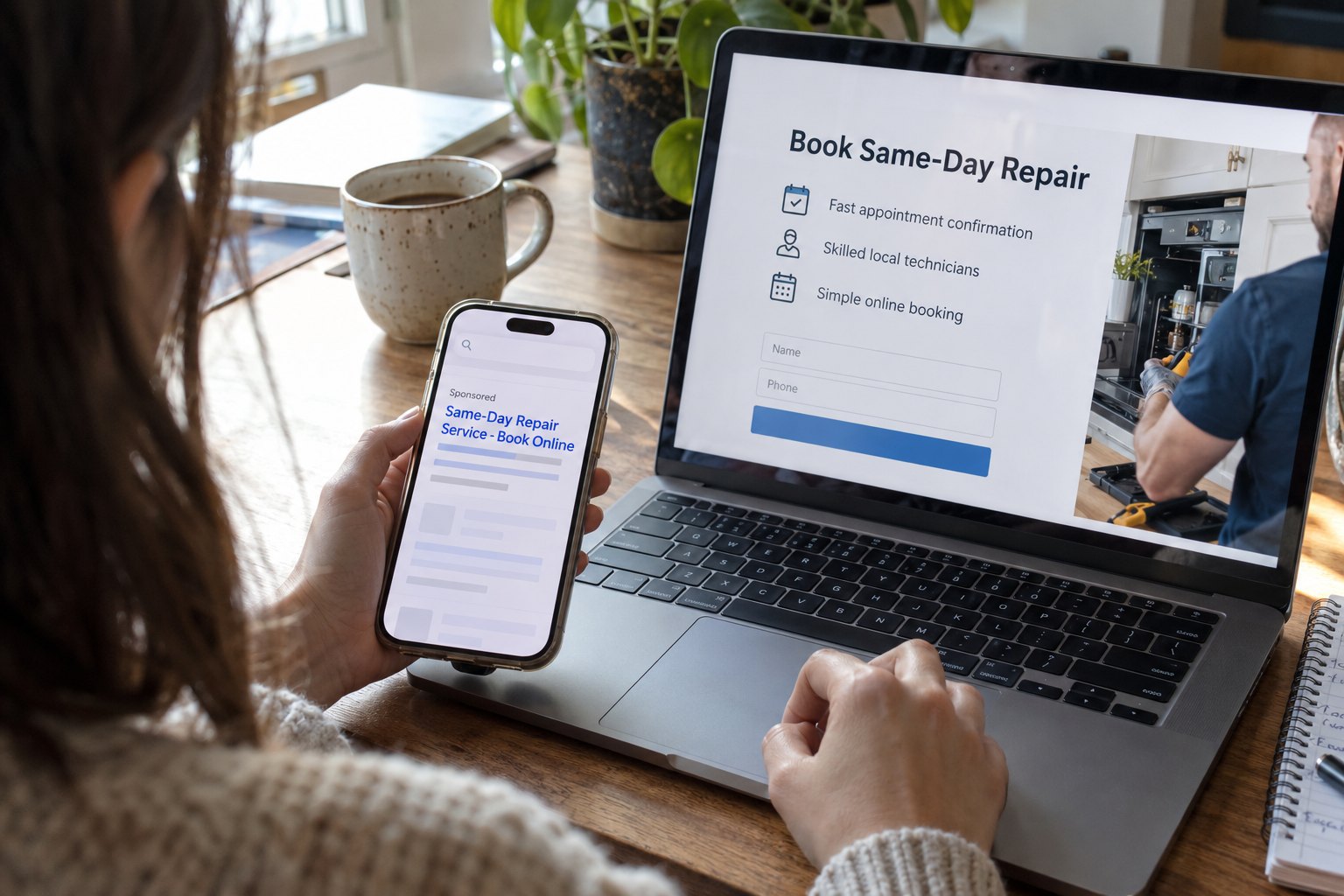
Most owners blame the ads when leads don’t convert. The ads are usually fine. The landing page is where the lead actually decides to call or to leave. The patterns that lift conversion on a service-business landing page are the same every time: a hero headline that mirrors the search query, a tappable phone number above the fold, fewer than four form fields, a single primary call-to-action repeated three times down the page, and proof that’s specific (named clients, dated jobs) instead of generic.
The math: a campaign at a 2% landing-page conversion rate needs roughly twice the clicks of a campaign at a 4% rate to produce the same calls. Most service-business landing pages we audit sit between 1.2% and 2.5%. Pushing them to 4-5% is mostly a structural job, not a visual redesign. The conversion levers are spelled out in our conversion rate optimization workflow.
| Mechanic | Typical lift | Effort | Common mistake |
|---|---|---|---|
| Negative-keyword hygiene | Cuts wasted spend by 30-45% | Weekly | Skipping the search-terms report |
| Geo-targeting set to “presence” | Stops out-of-area clicks cold | One-time, then quarterly | Default “presence or interest” |
| Landing-page hero matches query | Lifts conversion 25-50% | Per landing page | Generic homepage as the landing page |
| Tappable phone in mobile header | Lifts call volume 8-15% | 30-minute fix | Phone hidden in footer |
| Day-parting around when calls get answered | Higher conversion-to-job | One hour to configure | Running ads 24/7 with no answer plan |
Where Google Ads accounts actually break — and what fixes them.
Mechanic 4: Negative keywords are the hidden lever
Every service trade has a recurring set of search terms that look related but never convert. “DIY,” “jobs,” “hiring,” “salary,” “how to,” “free,” “near me cheap,” the names of competitors who outsource their support. Add them as negatives at the campaign level. Build a master negative list and apply it to every new campaign. Most accounts we audit have fewer than 20 negatives across the whole account when they should have 200-plus. The shared list is one of the higher-leverage assets in a properly run PPC operation.
Mechanic 5: Day-parting around when calls actually get answered
If your office answers the phone Monday through Friday, 8 to 6, but your ads run 24/7, you’re paying for clicks at 11pm Sunday that ring through to a voicemail. Half those leads are gone before Monday morning. Day-parting means scheduling the campaign to match your answer window — or, if you want to capture after-hours intent, routing those clicks to a landing page that sets the expectation (“text us, we’ll call back at 8am”) rather than a generic call CTA. Either is fine. Both beat the 24/7 default.

What to do this month
Pull your search-terms report for the last 90 days. Sort by spend. Highlight every term that didn’t drive a phone call or a form submit. Add them as negatives. Set location targeting to “presence.” Open your landing page on your phone — does the hero match what people are searching for, and is the phone number tappable above the fold? Five fixes, two hours of work, and most accounts we audit see the cost-per-call drop inside 30 days.
If you’d rather not run that exercise yourself, we’ll do it inside our PPC management service and we’ll bolt on the automate lead generation infrastructure (call tracking, CRM hand-off, missed-call text-back) on the same project. Month-to-month, no lock-in. We’ll show the audit before you sign anything.